







When it comes to tires, understanding the aspect ratio is crucial for making informed decisions about vehicle performance and safety. The aspect ratio represents the height of the tire’s sidewall as a percentage of its width. This seemingly simple number can significantly impact handling, ride comfort, and fuel efficiency.
Choosing the right aspect ratio can enhance a vehicle’s performance characteristics, making it essential for drivers to grasp its implications. A lower aspect ratio often means a sportier ride with improved cornering, while a higher ratio typically provides a smoother and more comfortable experience. By diving deeper into what aspect ratio means, drivers can better tailor their tire choices to meet their unique driving needs.
Understanding Aspect Ratio
Aspect ratio on a tire refers to the relationship between the height of a tire’s sidewall and its width. This ratio is expressed as a percentage. For example, if a tire has a width of 205 mm and a sidewall height of 55 mm, the aspect ratio is 55%. A lower aspect ratio signifies a shorter sidewall, typically found on performance tires. This design enhances handling and responsiveness, providing a sportier driving experience.
In contrast, a higher aspect ratio corresponds to a taller sidewall, commonly seen in passenger tires. This design enhances ride comfort by absorbing bumps and irregularities in the road. The choice of aspect ratio can also influence fuel efficiency; tires with a lower aspect ratio may reduce rolling resistance, improving fuel economy.
Drivers should consider their driving habits and vehicle requirements when selecting a tire’s aspect ratio. For instance, enthusiasts prefer lower ratios for better road handling, whereas those focused on comfort may opt for higher ratios. Understanding the implications of aspect ratio enables drivers to make more effective tire selections that align with their needs.
Analyzing the aspect ratio ensures an informed choice that balances performance and comfort, leading to an overall enhanced driving experience.
The Importance of Aspect Ratio
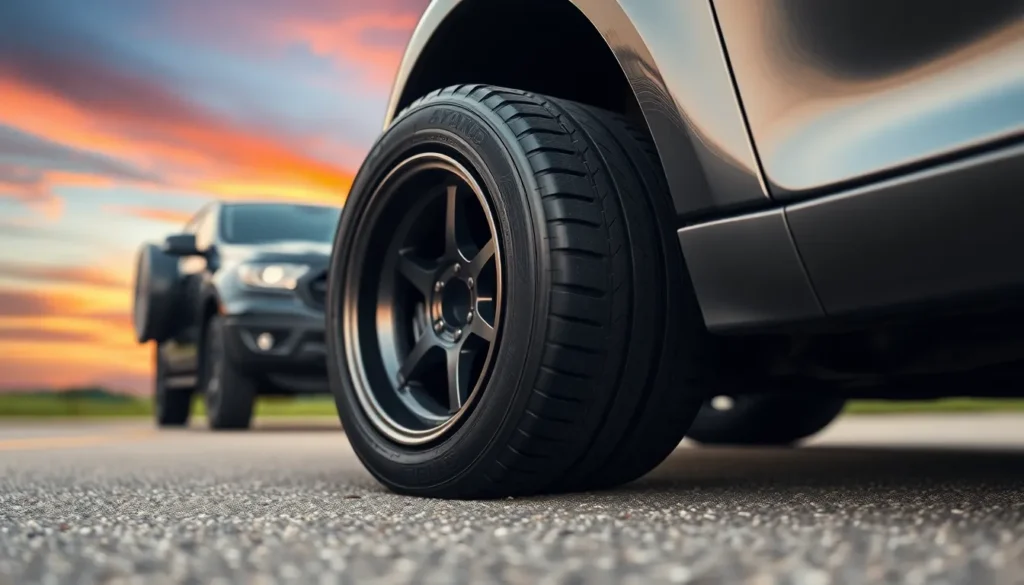
Aspect ratio plays a crucial role in tire selection, influencing various aspects of vehicle performance and longevity.
Impact on Vehicle Performance
Aspect ratio significantly affects handling and cornering capabilities. Lower aspect ratios, such as those found in performance tires, contribute to enhanced stability at higher speeds. Shorter sidewalls improve responsiveness, allowing for precise steering control. In contrast, higher aspect ratios typically enhance comfort in daily driving by providing a softer ride through increased sidewall height, which absorbs bumps and irregularities in road surfaces. This balance between sportiness and comfort allows drivers to tailor their vehicle’s handling characteristics based on their preferences.
Influence on Tire Wear
Aspect ratio also impacts tire wear patterns. Tires with lower aspect ratios tend to have a wider footprint, promoting even tire wear during cornering. However, a stiffer sidewall can lead to increased susceptibility to damage from road hazards. In contrast, tires with higher aspect ratios may wear more evenly in regular driving conditions, but they may not perform as well under aggressive driving. Proper selection based on aspect ratio can lead to reduced tire wear, promoting longevity and better overall performance.
How to Determine Aspect Ratio
Understanding how to determine aspect ratio is essential for selecting the right tire for optimal vehicle performance and comfort. This section describes how to read tire specifications and calculate the aspect ratio accurately.
Reading Tire Specifications
Tire specifications are typically printed on the sidewall of the tire. They follow a standardized format, often represented as “205/55R16.” In this example:
- The first number, 205, represents the tire width in millimeters.
- The second number, 55, signifies the aspect ratio as a percentage of the tire’s width.
- The letter R indicates the tire’s construction type, with “R” signifying radial construction.
- The last number, 16, denotes the diameter of the wheel in inches.
By examining these specifications, drivers can quickly identify both the width and aspect ratio of the tire, which influences their choice based on performance and comfort needs.
Calculating Aspect Ratio
Calculating aspect ratio involves simple mathematics. The aspect ratio is determined by dividing the tire’s sidewall height by its width and then multiplying by 100 to convert it to a percentage. Here’s the formula:
[ text{Aspect Ratio} = left( frac{text{Sidewall Height}}{text{Tire Width}} right) times 100 ]
For example, if a tire has a width of 205 mm and a sidewall height of 112.75 mm (55% of 205 mm), the calculation becomes:
[ text{Aspect Ratio} = left( frac{112.75}{205} right) times 100 approx 55% ]
Calculating the aspect ratio allows drivers to assess how changes in tire dimensions affect handling, ride comfort, and overall performance, leading to more informed decisions when selecting tires for specific driving conditions.
Different Aspect Ratios and Their Uses
Understanding the various aspect ratios assists in making informed tire selections tailored to specific driving needs. Each aspect ratio carries distinct characteristics that influence performance.
Low Aspect Ratio Tires
Low aspect ratio tires typically feature a sidewall height that’s less than 55% of the tire’s width. These tires excel in performance settings, as the reduced sidewall height enhances steering response and cornering stability. For instance, a tire with an aspect ratio of 35% provides aggressive handling ideal for sports cars and high-performance vehicles. Their design minimizes flex during turns, offering precise control at elevated speeds. However, these tires may sacrifice ride comfort and road noise reduction, as shorter sidewalls transmit more impact from road irregularities. Consequently, drivers who prioritize agility and performance often opt for low aspect ratio tires.
High Aspect Ratio Tires
High aspect ratio tires generally exhibit a sidewall height greater than 60% of the tire’s width. These tires are designed for comfort and durability, effectively absorbing shocks from uneven road surfaces. For example, a tire with an aspect ratio of 70% suits family sedans and SUVs, providing a smoother driving experience and enhanced safety during daily commutes. Higher aspect ratios promote better traction on various surfaces but may contribute to less responsive handling compared to their low aspect ratio counterparts. Drivers who favor a more comfortable ride often choose high aspect ratio tires, as they excel in providing stability and longevity under regular driving conditions.
Grasping the concept of tire aspect ratio is essential for any driver looking to optimize their vehicle’s performance and comfort. By understanding how aspect ratios influence handling ride quality and fuel efficiency drivers can make informed choices that align with their driving style. Whether opting for low aspect ratios for a sportier experience or higher ratios for a smoother ride the right selection can enhance both safety and longevity of the tires. With this knowledge in hand drivers can confidently navigate the tire market and select the best options for their needs.